


Related news
How to Choose Upholstery Staples by Gauge Crown and Leg Length
Choose upholstery staple sizes by matching the staple series to your gun, then checking wire gauge, crown width, and leg length against the fabric and frame. Use fine wire where appropriate for upholstery, allow enough penetration into sound backing, and test samples for fabric damage and protruding points before ordering.
A box marked “10 mm” tells you the leg length. It doesn’t tell you whether the staples will feed through your tool or hold a folded corner without cutting the fabric. For furniture makers and upholstery suppliers, a useful specification has to describe the whole staple.
1. Match the Staple Series to Your Upholstery Gun
Start with the tool manual or the staple reference printed on the gun. Record the exact model, accepted staple series, and permitted leg lengths. Keep the label from a previously approved box if you have one.
Series numbers help identify a fastener family, but names from different suppliers aren’t enough to establish interchangeability. Compare the manufacturer’s compatibility information and a dimensioned drawing. Crown width, wire cross-section, and strip construction must suit the magazine and driving mechanism.
Don’t load a near match because it looks right beside the old staple. A similar crown can conceal a different wire thickness. Where the manual and supplier description don’t agree, get written clarification before a sample trial.
If you’re selecting a new tool, work from the upholstery material and accessible fastening area first. Then choose a gun and approved staple family together. A product range may include more leg lengths than one particular gun can accept.
2. Read Upholstery Staple Sizes Beyond the Gauge Number
Fine wire is a sensible starting point for fabric attachment. A higher gauge number generally means thinner wire. A 22-gauge staple therefore has thinner wire than a 20-gauge staple within that classification.
Gauge is only part of the specification. Formed staple wire can have a rectangular cross-section, so request its width and thickness instead of treating the gauge number as a complete dimension.
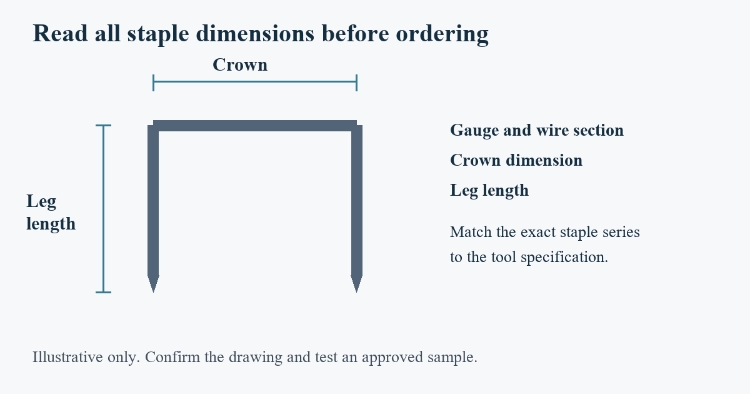
The crown is the bridge across the top of the staple. Its width affects how the staple sits over the fabric and whether it fits the tool. The legs pass through the covering into the backing. Increasing leg length doesn’t increase crown width or turn one staple series into another.
|
Specification |
What to check |
Why it matters |
|
Staple series |
Exact reference accepted by the gun |
Establishes the starting point for compatibility |
|
Gauge and wire section |
Gauge plus wire width and thickness |
Describes the wire more clearly than gauge alone |
|
Crown width |
Dimension and measurement convention |
Must suit the tool and fastening area |
|
Leg length |
Length approved for the gun and assembly |
Controls available penetration and protrusion risk |
|
Material and finish |
Steel grade and specified coating, if any |
Helps match the staple to moisture exposure |
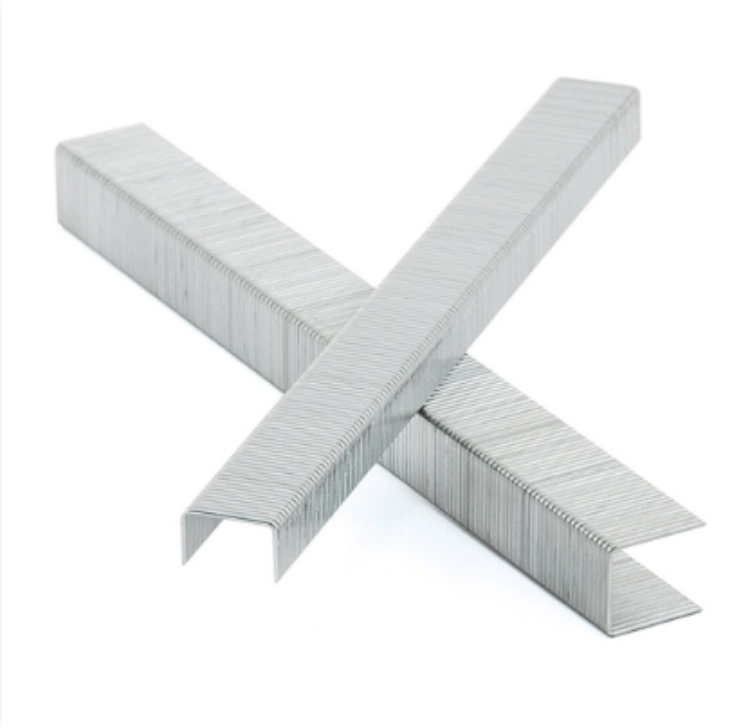
For a concrete example, Qinjia‘s 10J fine wire staple listing specifies 20GA, an 11.2 mm crown, and wire width and thickness of 1.20 × 0.60 mm. The listed leg-length range is 4–22 mm. These are product specifications, not a claim that every upholstery gun accepts 10J staples or every listed length.
Use a drawing when comparing metric dimensions with an inch-labelled product. Rounded catalogue labels aren’t a substitute for agreed dimensions and tolerances.
3. Choose Leg Length for the Actual Fabric and Frame
Measure the material at the fastening point. A flat run of fabric and a folded corner on the same seat can have different compressed thicknesses. Include any backing or trim that the staple must pass through there.
For thin fabric or plastic foil, a staple approximately 4 mm longer than the material thickness. This is a starting guideline for thin materials. It doesn’t establish a load rating or replace checks on the frame, tool, and actual assembly.
For example, a hypothetical 2 mm compressed fabric stack plus that 4 mm allowance points to a 6 mm leg as a trial candidate. This arithmetic doesn’t prove that 6 mm will work for your chair. The frame material may be damaged, the covering may pull differently, or the tool may require another approved size.
Check the backing thickness along the intended driving direction before firing. The portion of each leg extending beyond the compressed covering has to fit safely within the backing. A longer staple can emerge through a thin seat base or near the edge of a shaped rail.
Don’t select one maximum length for the entire job simply to reduce stock lines. Test representative flat sections and corners separately. If a fold needs more reach, confirm there is enough sound backing beneath it before moving to a longer staple.
Check the Condition of the Fastening Area
Old staple holes and broken board edges complicate reupholstery. A longer leg cannot repair a weak substrate. Inspect the area, remove loose debris, and decide whether the frame or seat base needs repair before choosing the final fastener.
Keep webbing and other heavily tensioned components outside a general fabric-size rule. Their fastening requirements need an application-specific decision. Upholstery contains several different joints; the staple that works for a dust cover may not suit every component beneath the seat.
4. Specify Material for the Service Environment
A dry indoor chair and upholstery used near water need different material reviews. Describe the expected exposure to your supplier, including regular wetting, coastal conditions, or cleaning chemicals. “For furniture” leaves too much unanswered.
The Qinjia 10J page lists Q235, SS304, and SS316 material options. Ask which grade and finish apply to the quoted item and request supporting documentation where your purchase specification requires it. A material option on a product page doesn’t mean every stocked length is immediately available in that material.
Avoid specifying “rustproof” as your only requirement. Record the actual grade, any coating requirement, and the intended exposure so both buyer and supplier can evaluate the same product.
5. Test Samples Before Approving a Bulk Order
Make a sample using the proposed fabric stack and the same backing material as production. Include the thickest fold you expect to staple. Follow the tool manufacturer’s setup and safety instructions, including eye protection and disconnecting power or air before clearing a jam.
Check more than whether the gun fires. Examine how the crown seats, whether the fabric is cut or pulled through, and whether the legs emerge from the opposite side. Compare a flat section with a folded corner. Apply the fabric tension expected in the assembly and inspect the fastening area again.
If crowns remain proud, check tool setup and compatibility before assuming you need a longer staple. If the crown damages the fabric, review the driving setting and staple choice. A successful trial should show acceptable seating and fabric retention without exposed points.
For repeat orders, keep an approved sample with its packaging label. Record the tool model, staple specification, backing, and setup used. That gives purchasing and production a shared reference when a later shipment looks different or feeds poorly.
Turn the Trial into a Purchase Specification
When reviewing a staple product range, narrow the order to the approved family and application. Send the supplier a specification containing:
- Tool make and exact model, approved series, and sample reference.
- Crown dimension, wire width and thickness, gauge, and required leg lengths.
- Material grade, finish, backing material, and intended exposure.
- Quantity by size, strip and box requirements, labelling, and acceptance checks.
Agree on substitutions before production. A different material or nominally similar crown should trigger a review rather than an automatic replacement on the order.
Frequently Asked Questions
What Type of Staple Is Best for Upholstery?
Fine wire staples are commonly appropriate for fastening upholstery fabric because they make a relatively small penetration mark. The final choice still depends on the covering, backing, and tool. Confirm the approved series and test the complete assembly, especially at folds.
What Size Staples Should I Use to Reupholster a Chair?
There isn’t one size for every chair. Measure the compressed covering at each fastening area, check the available backing thickness, and choose a compatible leg length for a sample trial. Rapid’s thin-material guidance of material thickness plus approximately 4 mm can help identify an initial candidate.
Are All Staples with the Same Gauge Interchangeable?
No. Staples with the same gauge can differ in crown width, wire section, leg length, and series geometry. Use the gun manufacturer’s approved staple reference and supplier dimensions to establish compatibility. Matching gauge alone is insufficient.
Request Samples with Your Tool Details
To discuss Qinjia upholstery staples, send your tool model and required staple dimensions together with the covering, backing thickness, and service environment. Include a drawing or approved staple sample where available, then confirm the specification through a trial before placing a bulk order.

 Consult
 Whatsapp
 Leave Message
 top
top