



Related news
Drywall Screw Length Guide for Single and Double Layer Boards
Choose drywall screw length by adding the board layers the screw must pass through to the penetration required by the specified framing system. For common single-layer work, 1-1/4-inch screws are a starting point for 1/2-inch board, while 1-5/8-inch screws are commonly considered for 5/8-inch board. Confirm the wall or ceiling specification before ordering: framing material, additional layers and resilient channels can change the answer.
A carton marked “drywall screws” does not tell a buyer whether it suits the assembly. Length, thread, point and head must work together. This guide explains how to compare sizes, check double-layer requirements and prepare an order that installers can identify without guessing.
Qinjia supplies drywall screws in several configurations. The useful starting point is your assembly requirement, followed by a confirmed product specification and sample.
Start With Board Thickness and the Full Assembly
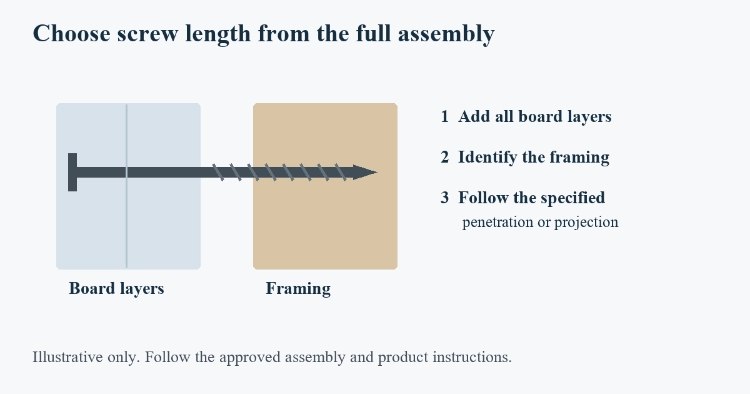
Measure everything between the screw head and the member that is intended to receive the fastener. A screw passing through two boards uses more of its length before reaching that member than one passing through a single board.
For direct attachment to wood framing, this can be expressed as a selection check:
Required length = material thickness before the framing + specified penetration into the wood.
The penetration requirement must come from the applicable board instructions, assembly specification or local requirements. The formula does not establish that requirement. It also does not determine screw diameter, spacing or suitability for a tested fire-rated assembly.
With steel framing, check the specified screw point, supported steel thickness and required projection beyond the steel. Do not copy a wood penetration allowance into a metal-stud order. If channels are present, follow the system instructions to identify the intended fixing member and approved screw length.
Record These Details Before Selecting a Size
- Board type, individual thickness and number of layers.
- Wood framing, steel framing or a specified channel system.
- Wall or ceiling location and any rated assembly reference.
- Approved fastener type, penetration or projection, and spacing.
These details let a distributor separate orders that look similar on a purchase list but need different screws on site.
Common Drywall Screw Lengths as a Starting Point
Below table lists the following length options by board thickness. Treat them as manufacturer guidance for initial selection, then verify the actual assembly. They are not a universal schedule for every wall, ceiling or country.
|
Single board thickness |
Listed screw length options |
Confirm before use |
|
1/4 inch |
1 inch or 1-1/4 inches |
Backing and required penetration |
|
1/2 inch |
1-1/4 inches or 1-5/8 inches |
Framing and assembly instructions |
|
5/8 inch |
1-5/8 inches or 2 inches |
Rated detail and framing system |
The alternatives in the table are not interchangeable simply because both appear in a guide. A contractor may have a specified screw schedule, while a procurement team may be comparing several board systems. Resolve that distinction before combining requirements into one stock item.
Keep Metric and Inch Orders Consistent
Record the requested nominal size and its unit. For example, 1-1/4 inches equals 31.75 mm, while 1-5/8 inches equals 41.275 mm. A catalogue size of 30 mm or 40 mm should not silently replace either one.
Nominal product labels sometimes use rounded equivalents. Ask the supplier to confirm the actual dimensional specification and tolerance on the drawing or order acknowledgement. If the assembly needs a particular minimum length, check the proposed metric size against that requirement rather than relying on a rounded carton label.
Select Double Layer Screws From the Specified Fixing Detail
Two layers require a fresh length check. If the outer layer must be fixed through the inner layer into framing, include both board thicknesses. If an approved system specifies board-to-board lamination fasteners, that is a different fastening detail with its own requirements.
Consider a calculation example, not an installation prescription: two 1/2-inch boards create a total board thickness of 1 inch. A 1-1/4-inch screw would leave only 1/4 inch of its nominal length beyond those boards before allowing for seating geometry. That calculation explains why carrying over a single-layer screw can leave too little length for the required fixing.
Use the same process for two 5/8-inch boards, mixed layers or an overlay on an existing finish. Confirm what is actually behind the board. A drawing that assumes direct fixing into studs is not enough if the site includes another lining, furring or channels.
For fire-rated or acoustic work, follow the named assembly’s fastener type, layer sequence and fixing schedule. “Use a longer screw” is incomplete advice because length alone cannot establish compliance with that detail.
Match Thread and Point to the Framing
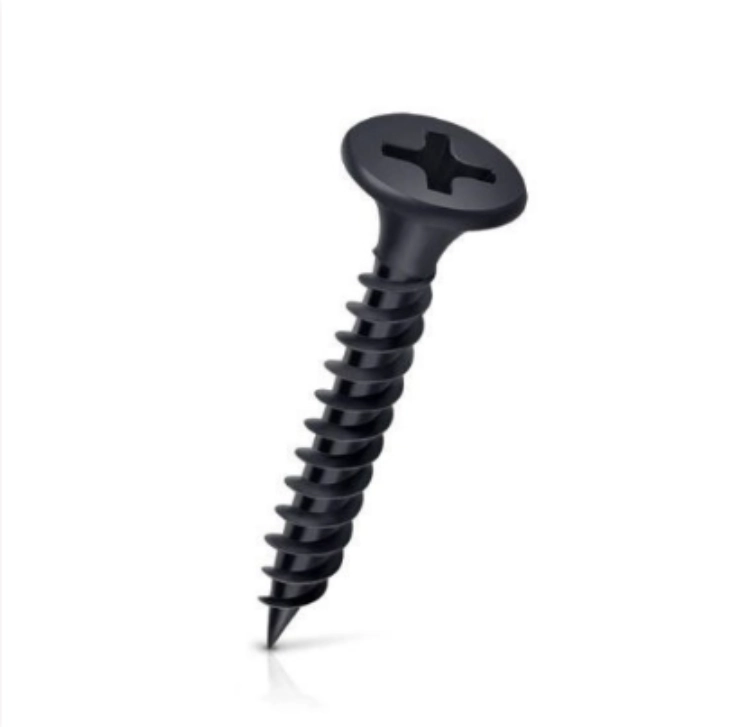
Coarse-thread drywall screws are commonly used for wood studs; fine-thread versions are commonly used for light-gauge steel. Grip-Rite describes that distinction in its product guidance. Keep the framing type on the specification even when screw lengths are identical.
Steel thickness also matters. A sharp-point screw and a drill-point screw are not automatically substitutes. Obtain the selected product’s supported steel thickness and fastening instructions; the words “fine thread” do not establish its drilling capacity.
Qinjia’s product page lists several thread, head and finish options. A quotation should identify the exact combination being offered. Avoid ordering from a broad catalogue description that could refer to multiple configurations.
For a conventional paper-faced gypsum board application, the specified head must seat correctly without tearing the face. Do not substitute a different head style merely because it is listed beside the same length in a supplier’s catalogue.
Check Seating and the Working Environment
The correct screw should hold the board snugly while its head sits just below the surface without breaking the paper face. A screw that spins, stands proud or tears through the paper needs investigation. The cause may involve the substrate, screw selection, tool setting or installation technique.
Evaluate a sample on a representative assembly before approving bulk stock. Check whether the point starts properly, the screw engages the framing and the head seats consistently. Use the tool’s instructions when setting depth or speed; increasing force is not a reliable correction for an incompatible fastener.
Longer screws are not automatically better. Excess length may create unnecessary projection or conflict with the specified fixing detail. Check concealed services and the intended fixing zone before installation.
The finish also needs to match the environment. Grip-Rite cautions that its conventional drywall screws are not suitable for treated lumber or exterior locations susceptible to rust. For Qinjia products, confirm the selected finish and its intended exposure conditions. A black or zinc-coloured appearance alone does not establish exterior suitability.
Prepare a Clear Bulk Order for Qinjia
Start the enquiry with the board assembly, then list the required fastener dimensions and configuration. State whether quantities are by piece, box or weight so quotations can be compared on the same basis.
Include the following in an order specification:
- Nominal diameter and length, units, dimensional tolerances and agreed drawing.
- Thread type, point, head, drive recess and finish.
- Framing material and the board layers the fastener must pass through.
- Loose or collated supply, with tool details for collated products.
- Quantity per box, carton markings and any inspection documents required.
Confirm availability of the exact combination on your order. A broad catalogue length range does not mean every diameter, point and finish is stocked in every length. Ask for a current drawing and written confirmation of any proposed substitution.
Qinjia’s OEM and ODM process includes sample review before production. Use that stage to agree the specification and packaging. Keep an approved sample and its reference number so later deliveries can be checked against the same item.
Send your board thickness, layer count, framing details and required quantities through Qinjia’s enquiry page to request a matched specification and sample.
Frequently Asked Questions
What length screws should I use for 1/2 inch drywall?
Grip-Rite lists 1-1/4-inch and 1-5/8-inch options for 1/2-inch board. Choose the size required by your framing and assembly instructions. Additional layers or channels can change the selection.
Can I use 2 inch screws for drywall?
A 2-inch screw can suit some specified assemblies, and Grip-Rite lists it as an option for 5/8-inch board. It is not the default for every installation. Confirm the intended fixing member and required penetration or projection.
Do ceilings always need longer screws than walls?
Do not determine length from the location alone. Board layers and the fastening detail control length; the ceiling specification may also set different fastener spacing. Check both requirements separately.
Is a number 8 screw longer than a number 6 screw?
No. Those numbers identify nominal screw diameter, not length. An order needs both dimensions, along with the thread, point and head required by the assembly.

 Consult
 Whatsapp
 Leave Message
 top
top