



How to Drive Cement Nails Into Concrete Without Bending or Cracking
Concrete nails, known as cement nails in many countries, are useful for fixing into concrete and solid masonry. However, a hardened nail will not penetrate all surfaces. The penetrating ability of a nail into concrete is influenced by the concrete strength, the type of aggregate used, the nail geometry, the embedment depth as well as the correct use of the nail.
While it is easy to just hit it harder when your nails keep bending or your surface starts to chip, the amount of pressure required to drive nails can cause damage to your product. Below are the steps to hand nail properly, common problems that can occur during installation and how to avoid them, and how drilled fixings could be a more suitable option.

Quick Answer: How Do You Stop Cement Nails From Bending?
The hardened concrete nail should be chosen specifically for the base material, the length required for the attachment and the required embedment into the structure. The nail should be struck square to the surface with light controlled blows initially, keeping the hammer aligned with the nail as the fixing is driven home. If the nail bends, stops in the material or causes surface cracking, the method of fixing should be reassessed.
Can You Hammer Cement Nails Directly Into Concrete?
Rarely. In some cases hand-driven concrete nails can be used for light non-structural work on suitable concrete or dense masonry. However very hard concrete, coarse aggregate, brittle edges and weak or hollow masonry often do not lend themselves to direct nailing. You must follow the nail maker’s installation instructions for the product and the base material must be of a suitable condition for direct fastening.
A correctly specified fixing system should be used for structural connections, overhead or safety critical features etc. to establish a verified load bearing capacity as opposed to a general purpose cement nail.
Why Do Concrete Nails Bend or Chip the Surface?
- Nail and substrate mismatch: Normal low-carbon nails will buckle under load, whereas very hard nails will also break under load. In some cases, the hard aggregate in the substrate can even push a suitable steel nail off track.
- Off-centre blows: An angled first blow or a moving workpiece in the work area will generate side loads that can bend the shank before the point penetrates the base material.
- Incorrect geometry or positioning: Diameter, point form of the fastener and embedment depth of the fastener have a significant effect on the driving action. Fasteners positioned too close to an edge or existing crack are prone to spalling.
- Unsuitable base material. The listed materials are examples of base materials which do not provide a stable fixing point for hand-nailing, e.g. crumbly mortar, hollow block, thin concrete layers, heavily reinforced areas etc.
How to Drive Cement Nails Into Concrete: 6 Steps
1. Check the base material and the load
Check that the wall or slab is sound enough to take a hand-driven nail. Identify any concealed cables, pipes etc. and mark the intended position for the nail. Do NOT assume that an untested nail has been rated as a structural anchor.
2. Choose a compatible hardened nail
Determine the point style, shank diameter and length for the substrate and the fixture thickness. Long nails are not necessarily stronger and can be more difficult to drive. Use a fastening system with documented performance if the connection needs to carry a given load.
3. Mark a safe fixing point
Concrete with visible cracks or damage must not be used. Ensure minimum edge distance and spacing for the fixings. Timber strips or brackets to be fixed must be sufficiently fixed to prevent movement. Impact resistant safety glasses with side protection must be worn when working with chipped concrete and metal etc. to prevent injury to eyes from sharp fragments.
4. Set the nail straight with light taps
Hold nail upright against concrete surface and use appropriate hammer to gently tap point of nail into place with a few light blows. For short nails use a nail holder or remove nails with pliers and hold in fingers behind hammer for safety.
5. Drive with controlled, aligned blows
After seating the nail, slowly increase the amount of force while maintaining proper alignment between the hammer face and the head. Do not strike off center as this can cause the nail to bow or even deform the head of the nail. If the nail begins to bow, the head of the nail deforms, or you notice concrete chipping away from the hole, cease driving the nail as further attempts to drive the nail through the concrete can cause severe damage to the base of the wall.
6. Inspect the finished fixing
Check that the nail has been seated correctly, the item is securely attached and the surrounding concrete is sound with no signs of excessive cracking or spalling. A bent or damaged nail should not be attempted to be straightened for reuse. If a particular installation does not hold, look for an alternative fixing to use at that point rather than continuing to attempt to drive the same nail into the same spot.
Which Concrete Nail Type Should You Use?
There are specific concrete nail designs, and you must match the shank type to the type of attachment, the base material, and the method of installation. Verify the holding power by application tests or by the supplier’s technical information and do not confuse with similar looking nails.
|
Nail type |
Typical use |
Selection point |
|
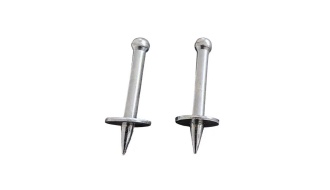
Smooth-shank concrete nails |
Hand-driven fixing into light-duty concrete or solid masonry. |
This is a simple product to install. The performance of the product depends on the type of nail used and the type of substrate it is being fastened into. |
|
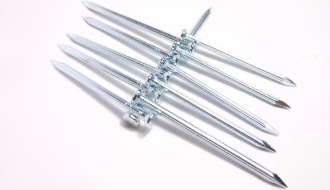
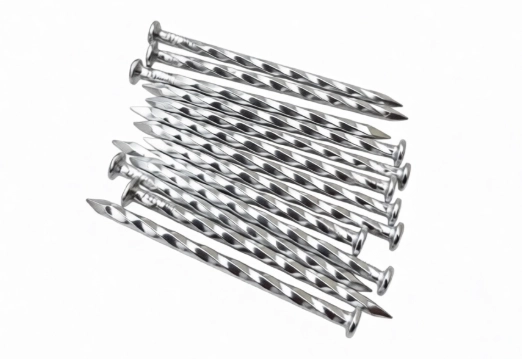
Angular spiral concrete nails |
Selected masonry or wood-to-masonry applications where the profile may improve grip. |
Please test for driving suitability and withdrawal resistance on the material in question. |
|
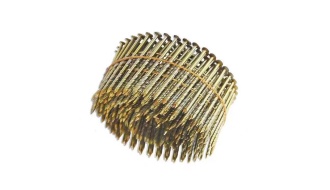
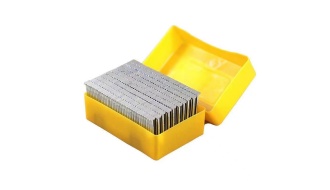
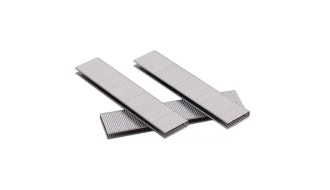
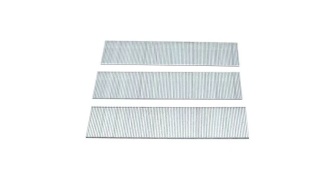
14-gauge concrete T/ST nails |
Repeated fastening with a compatible concrete nailer |
Check exact nailer model, magazine configuration, and operating instructions. Use hand nails for work that can’t be done with a nailer. |
How to Select Nail Length, Steel Grade and Finish
Length and embedment
Select length of anchor based upon thickness of material to be fixed plus depth of embedment for fixing. Excess length of anchor does not give additional performance and only causes increased resistance to driving. Insufficient embedment reduces holding capacity. Check minimum base thickness and edge distance prior to fixing.
Steel grade and hardness
For hardened concrete nails heat-treated medium-carbon steel is the common material. The nail’s hardness determines its penetration, but also its impact toughness. The latter has to be greater than the hardness. For such properties ask the supplier for the actual steel grade, for the test method for hardness and for the results of the lot in question.
Coating and service environment
Different products have different appearance requirements, packaging requirements and storage requirements. Just because a product has a decorative or thin zinc coat, does not mean it is suitable for outside, wet, corrosive applications. Check the coating specification and the required corrosion resistance.
Qinjia Product Range: Specifications to Confirm
The above table provides an overview of the Qinjia products featured on this page. Please confirm the material grade, hardness, dimensions, packaging and tool compatibility with the approved product drawing and corresponding quality documents prior to ordering. For specific product information please refer to the corresponding pages for the smooth shank concrete nails, Angular spiral nails and 14 Gauge Concrete T nails.
|
Product series |
Material / nominal size |
Range / packing |
|
Smooth-shank concrete nails |
45# / 1045 / S45C steel family |
We can make available sizes and packaging in accordance with your order. Please advise the finished nail hardness. |
|
Angular spiral CMAS25–CMAS150 |
55# / 1055 / S55C steel family; shank Ø 3.2–5.0 mm |
Lengths 25–150 mm; OEM packing options. |
|
Concrete T/ST nails ST15–ST64 |
45# or 55# steel family; nominal 14 gauge (about 2.18 mm) |
Lengths 15–64 mm; listed pack: 40 nails/stick, 1,000/box. |
For ST/T nails, tool compatibility is crucial. “14 gauge” does not necessarily mean that the nail is compatible with all concrete nailers. Compare exact model, nail profile, collation and length range specified before ordering.
Concrete Walls, Brick and Wood-to-Concrete Fixing
Concrete walls
For light strips or brackets choose an area of the wall which is sound with no signs of cracking or local damage. If the base concrete is very dense, in addition to potentially chipping immediately, penetration may be inconsistent. In such cases use an alternative system approved for use in that type of concrete.
Solid brick and masonry
Hardened masonry nails can be used for very dense solid brickwork but the risk of failure in soft mortar joints, weak bricks, blocks and hollow masonry units is different. This must be established by a site investigation and the type of masonry found.
Wood-to-concrete attachments
Timber should be fixed prior to nailing and allow for the thickness of the timber and the required concrete embedment. Load bearing timber connections, timber that is preservative treated or to be exposed, would require a fastening solution that is capable of withstanding the required loads and corrosion.
When Is a Drilled Anchor Better Than a Concrete Nail?
A concrete screw, plug-and-screw system or engineered anchor is generally the better choice when concrete is too hard for straight penetration, constant loads are to be assured, or when concrete cracking and edge distance are critical design parameters. Also, if a manufacturer requires pre-drilling of fixings, then ensure that the drilling process is in accordance with the specified diameter, depth and hole-cleaning process. Drilling a pilot hole for a nail is not advised and must only be done if the nail was specifically designed for this purpose.
Concrete Nail Buying Checklist for Importers and Contractors
When comparing different batches or preparing an RFQ, don’t just focus on the nominal length of the fasteners. Other conditions also have to be specified.
- Substrate and application: concrete strength/type, solid brick or block, thickness of fixtures, expected loads and application environments.
- Nail construction: head, point, shank profile, diameter and length range; material grade and heat treatment.
- Quality evidence: dimension tolerances, hardness testing, coating specification and any relevant application/withdrawal test data.
- Installation: hand driving or using the exact concrete nailer model. Includes collation and the correct nail for the model.
- Commercial details such as order quantities, packaging in carton or stick format, required label languages and OEM branding requirements.
Frequently Asked Questions
Can cement nails be driven into very hard concrete?
Dense concrete or hard aggregate can prevent penetration of nails or cause them to bend or break. Test fixings need to be treated with caution and if any fail, stop immediately and change to drilled or engineered fastenings as suitable.
Are angular spiral nails always stronger than smooth-shank nails?
There is no universal comparison. Grip is largely determined by the shank profile, but holding power is largely a function of nail dimensions and the concrete/masonry it is to be embedded into, and the method and depth of installation tested.
Do longer concrete nails hold better?
Embedding a post correctly is more important than its maximum length. Excessive driving depth of a post can create unnecessary resistance or even cause damage. Follow the specific guidance for your product.
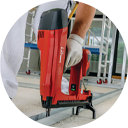
Can 14-gauge concrete T nails be installed with a hammer?
ST/T products are for use with compatible concrete nailers. Use with approved equipment for specific product sizes and format only.
Are electro-galvanized cement nails suitable outdoors?
The suitability of any coating is dependent on the coating’s specification, the moisture content and any corrosive exposures encountered. Check the project’s requirements prior to specifying a finish – ‘galvanized’ is not generic enough.
Get a Specification Match from Qinjia
Hebei Qinjia Metal Products Company, founded in 1997, specializes in manufacturing of smooth-shank concrete nails, angular spiral nails, concrete T/ST nails as well as in manufacturing of OEM packaging for nails. In order to prepare an offer for you, please provide us with information about substrate, fixture thickness, about your nailer model (if any), about desired dimensions, about surface finish as well as about packaging requirements.

 Consult
 Whatsapp
 Leave Message
 top